
“Clustered Index” Doesn’t Mean What You Think It Means (And That’s Alright!)

Early this week, during a book club session, I found myself stumbling through the nuances of clustered indexes, index-organized tables and covering indexes, only to be corrected by fellow readers that were going strictly by Kleppmann and Riccomini’s Designing Data-Intensive Applications (2nd Edition, 2026). Driven by my confusion, I hit the books and the web to untangle it all.
While I’d learned it first from Silberschatz, Korth & Sudarshan’s Database System Concepts (currently on 7th Edition, 2021), and a couple of lesser-known books, Kleppmann and Riccomini’s definition matches something else entirely. And it turns out their usage is the one that matches the industry’s actual database engine implementations! Therefore, neither of us were way off during the book discussion or inventing anything, for that matter; we were just each drinking from different wells. 🥲
This post is the writeup I wish I’d had going into that conversation. ;-)
The claim that started it
The definition I knew, in Silberschatz, Korth, and Sudarshan’s own words:
“… a clustering index is an index whose search key also defines the sequential order of the file. Clustering indices are also called primary indices; the term primary index may appear to denote an index on a primary key, but such indices can in fact be built on any search key. The search key of a clustering index is often the primary key, although that is not necessarily so. Indices whose search key specifies an order different from the sequential order of the file are called non clustering indices, or secondary indices. The terms “clustered” and “nonclustered” are often used in place of “clustering” and “non clustering.”
In other words, they describe a clustering index as one where the heap file itself is ordered according to the index search key.
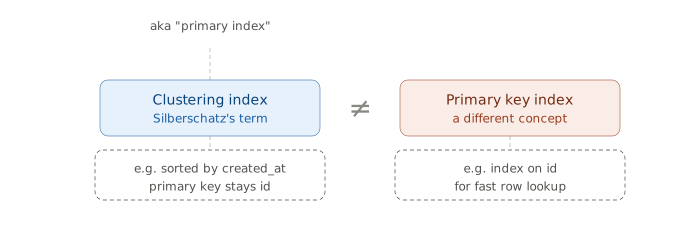
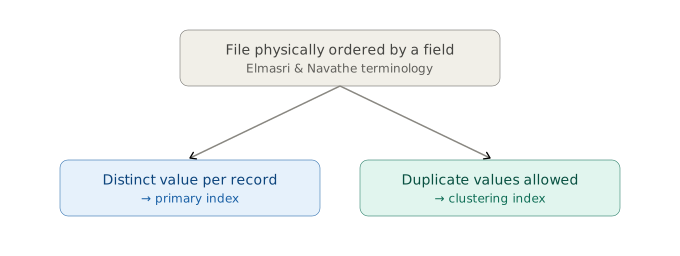
But if we check the literature a bit further, Elmasri and Navathe’s Fundamentals of Database Systems (7th ed, 2016) has an even more specific definition of Clustering Indexes:
“If file records are physically ordered on a nonkey field — which does not have a distinct value for each record — that field is called the clustering field and the data file is called a clustered file. We can create a different type of index, called a clustering index, to speed up retrieval of all the records that have the same value for the clustering field. This differs from a primary index, which requires that the ordering field of the data file have a distinct value for each record. A clustering index is also an ordered file with two fields; the first field is of the same type as the clustering field of the data file, and the second field is a disk block pointer. There is one entry in the clustering index for each distinct value of the clustering field, and it contains the value and a pointer to the first block in the data file that has a record with that value for its clustering field.
(…)
A clustering index is another example of a nondense (E.N., sparse) index because it has an entry for every distinct value of the indexing field, which is a nonkey by definition and hence has duplicate values rather than a unique value for every record in the file.”
There’s a subtle distinction worth flagging here. In Elmasri and Navathe terminology, if the physical ordering field is the primary key, they normally call the associated index a primary index, not a clustering index.
Independently, Oracle has used the term Index-Organized Table (IOT) since at least Oracle8, though the underlying idea predates the name. In Oracle’s own docs, an IOT is a table with no separate heap file, that is, the data lives directly inside a B-tree, keyed by (typically) the primary key.
DDIA collapses both of these into a single definition:
“If the actual data (row, document, vertex) is stored directly within the index structure, it is called a clustered index. For example, in MySQL’s InnoDB storage engine, the primary key of a table is always a clustered index, and in SQL Server, you can specify one clustered index per table [43].”1

But that’s not an error on their part! It’s the terminology MySQL’s InnoDB, SQL Server and TiDB, among others, actually use in their own documentation. The “clustered index” in their world is what Oracle calls an index-organized table. Same structure, different products/companies, different words.
Markus Winand’s SQL Performance Explained (2nd edition, 2025) reconciles IOT and clustered index definitions, as quoted below:
“Some databases can indeed use an index as primary table store. The Oracle database calls this concept index-organized tables (IOT), other databases use the term clustered index. In this section, both terms are used to either put the emphasis on the table or the index characteristics as needed. An index-organized table is thus a B-tree index without a heap table. This results in two benefits: (1) it saves the space for the heap structure; (2) every access on a clustered index is automatically an index-only scan. Both benefits sound promising but are hardly achievable in practice.”
Three structures, one collision
Before getting to the confusing part, here’s the structure everyone agrees on and the baseline the other two get compared against.
1. The baseline: heap file + ordinary secondary index
Rows sit in an unordered heap and a B+-Tree index points into it.
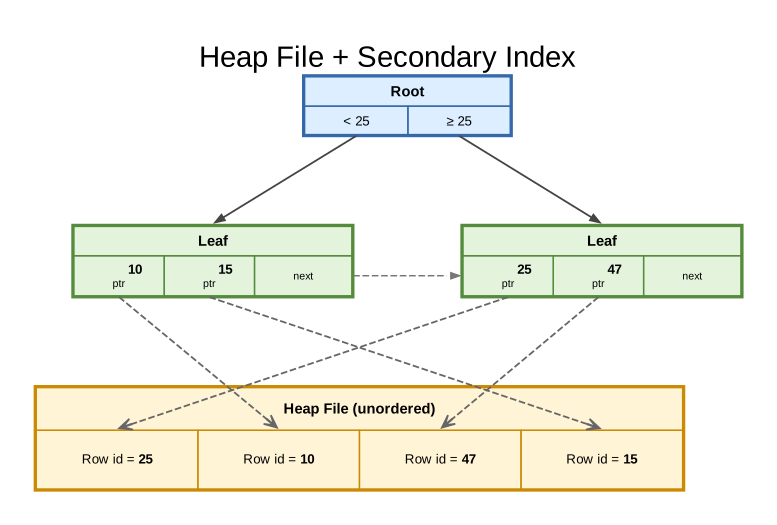
2. “Clustering index”: the academic vernacular (Silberschatz’s/Navathe’s)
The heap file is still there, but it’s been physically sorted to match the index key. Because order matches, the index doesn’t even need an entry for every row, one entry per disk block is enough (i.e., it can be a sparse index).
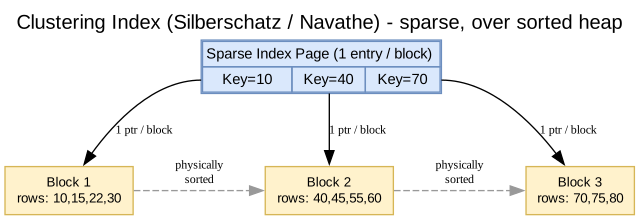
The important detail: this is a maintained property, not a structural guarantee. New inserts can land out of order until the next reorganize. OPTIMIZE TABLE in MySQL’s MyISAM engine, or CLUSTER in PostgreSQL are both real-world instances of this exact concept.
Db2 goes a step further than MySQL and PostgreSQL: it names this concept directly. Its own documentation describes a clustering index as one that determines how rows are physically ordered in a table space; a genuinely separate object from the table, exactly like Silberschatz’s model. Db2 even tracks a cluster ratio to measure how well-sorted the heap currently is, and recommends a REORG when it drifts.
One caveat: Db2’s clustering index is still a dense (B-tree) index, with one entry per row. Silberschatz’s definition allows the index itself to go sparse once ordering is guaranteed, but Db2 doesn’t take that shortcut. So it’s a real match on the heap-file question, just not on the sparse-index detail.
3. “Clustered index” / index-organized table: the engineering vernacular (InnoDB, SQL Server, Oracle IOT, TiDB)
No heap file exists. The B-tree’s leaf nodes directly hold the row data.
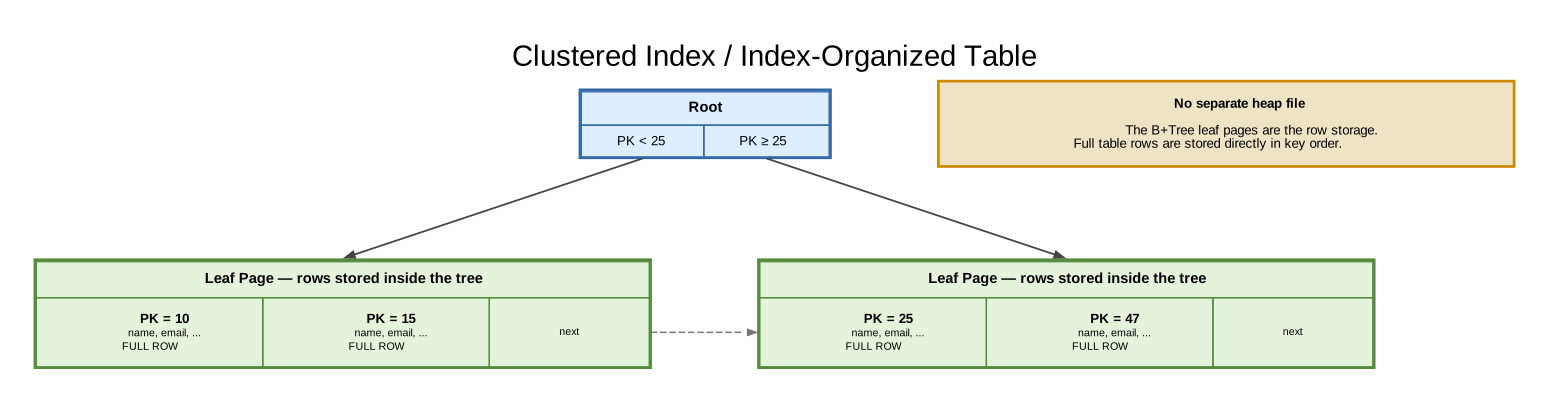
Here the sort order isn’t something you maintain. It’s structurally impossible to violate, because there’s nothing to fall out of sync. The row is the leaf.
One more consequence follows directly from structure 3:
4. The two-hop cost of secondary indexes on a clustered index
Once there’s no heap to point into, a secondary index (say, on email) can’t store a physical rowid. It stores the clustering key instead, then does a second lookup into the clustered B-tree index to fetch the row.
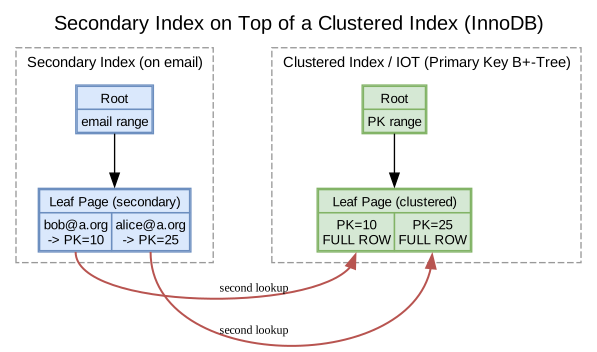
This two-hop pattern is exactly what Kleppmann and Riccomini are describing when they discuss the cost of secondary indexes on clustered-index tables in DDIA book!
By the way, Winand lays out exactly why this hurts once you add a second index on top of a clustered one. As the rows inside an index-organized table can move at any time to preserve B-tree order, a secondary index can’t store a physical pointer (rowid) to them, so it has to store the clustering key (often the primary key) instead and use that to look the row up.
In practice, this means every lookup through a secondary index costs two searches instead of one: an INDEX RANGE SCAN2 on the secondary index, followed by an INDEX UNIQUE SCAN3 into the clustered index for each match. By the way, I am borrowing Oracle’s EXPLAIN PLAN vocabulary here purely as an illustration of the two-hop pattern; InnoDB and SQL Server surface the same cost under their own plan-operation names. As Winand puts it, “accessing an index-organized table via a secondary index is very inefficient.”
The fix is the same one used for heap tables: an index-only scan, though here it’s better described as a “secondary-index-only scan”; and the payoff is even bigger, since it eliminates an entire INDEX UNIQUE SCAN per row rather than a single table access.
Why the definitions collided
- Oracle calls this structure an index-organized table and reserves cluster for something unrelated (i.e., multiple tables sharing storage blocks by a cluster key);
- MySQL/InnoDB and Microsoft SQL Server call the same structure a clustered index;
- Classical database texts like Silberschatz et al’s and Navathe et al’s are describing a different axis of classification: does index order match file order? Not whether the heap exists at all…
- IBM Db2 is the outlier that actually lines up with the classical texts: its clustering index is a genuinely separate object from the table, and Db2 tracks how well the two stay in sync, that is, the same axis Silberschatz is describing, not the IOT axis Oracle/MySQL/SQL Server are on.
Two structures, several vocabularies, one underlying set of concepts, with Db2 being the rare case where a vendor’s terminology and the classical textbook terminology actually agree. But none of the sources is “wrong” in isolation; the confusion only shows up when you read across them, or cross-references them, which is exactly what happens in a book club drawing on multiple references.
Bonus round: covering index (no controversy here!)
Not every indexing term is contested. While looking into this, I also revisited covering index, as defined in Markus Winand’s SQL Performance Explained (2025). Unlike the clustered/clustering mess, this one is consistent everywhere: SQL Server docs, PostgreSQL literature, Couchbase docs, and Winand’s book all agree:
A covering index contains every column a query needs —
SELECT-list columns as well asWHEREandJOINcolumns —, so the database engine never has to visit the underlying table at all.
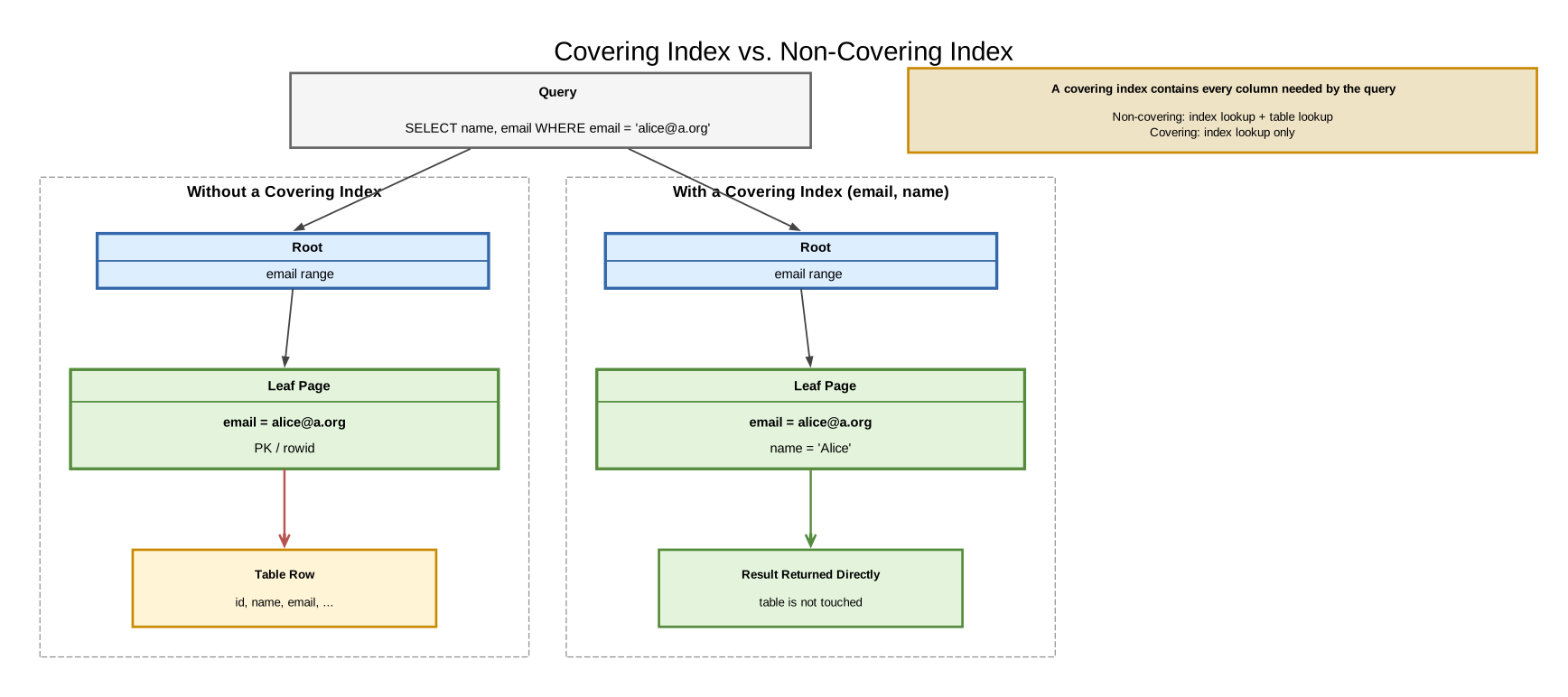
Or specifically quoting Winand’s book:
“If an index prevents a table access it is also called a covering index.The term is misleading, however, because it sounds like an index property. The phrase index-only scan correctly suggests that it is an execution plan operation.”
The nice part: this concept is orthogonal to the clustering debate above. It applies whether you’re skipping a hop to a heap file (Silberschatz et al’s clustering index) or skipping a hop into a clustered B-tree (DDIA’s clustered index).
By the way, a YugaByte’s blog post goes further by citing other covering indexes’ diverse names:
“The solution is simple and has many names: “covering index”, “include index”, “projection index”, “fat index” and even “Tapio index” from the name of the author of “Interscience Relational Database Index Design and the Optimizers” (Tapio Lahdenmäki) who explained this in detail.”
But, all in all, they’re all aliases/nicknames for the same mechanism, not competing definitions. Phew! 😅
A key takeaway
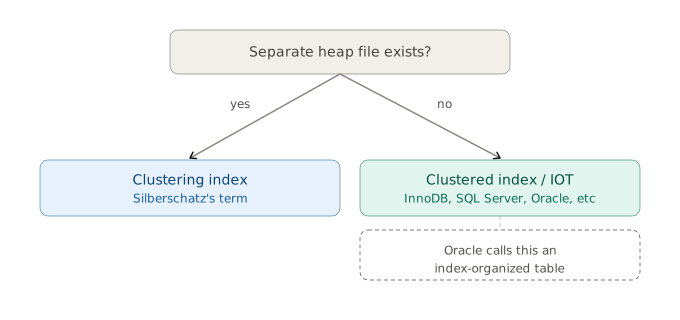
If you’re reading multiple database books then assume “clustered/clustering index” means different things depending on which book is in your hand, until proven otherwise. When in doubt, ask yourself: is there a separate heap file here, or not? That question cuts through the vocabulary every time.
Cheers!
Edward
August, 28th, 2026
-
More precisely, if a table has no primary key, InnoDB clusters on the first unique NOT NULL index instead, or a hidden internal row ID as a last resort, as discussed here and here. ↩
-
Index Range Scan is a database operation where the system traverses an index tree to find a starting point and then walks through connected leaf nodes to read a targeted range of matching entries. Source: Use The Index, Luke — Execution Plan Operations. ↩
-
INDEX UNIQUE SCAN is a database operation that performs a B-tree traversal to find a single, specific row using a unique index. Source: Use The Index, Luke — Execution Plan Operations. ↩